
“Open the primaries” is the wrong answer to the right question
Why isn't November the election that matters? Single-member districts are the problem. Primary reform doesn't fix that.

Ask a despairing pundit or member of Congress how to fix our politics, and there’s a decent chance they’ll offer this simple bromide: “We need to open the primaries. Let independents vote in primaries.”
I get the intuition. If “open the primaries” ever sounded right to you, you noticed something true. Most November elections are not competitive, and becoming even less so. Most elections are decided in April or May or June, in the primaries. So shouldn’t everybody get to vote in that election?
Except there is something very strange about this answer. Actually a few very strange things.
Strange thing number one is that registered independents can already vote in party primaries in most states, and they have been able to for decades. So saying we really should do the thing we are mostly already doing is an odd reform idea.
Strange thing number two is that states where independents can vote in primaries (again: most states!) are not notable bastions of democratic healing. Representatives elected in open primary states do not behave any differently in Congress. They are not more independent or more bipartisan. They are not more likely to stick around if they’re out of step with their party. This is also true for the top-two states.
Strange thing number three is that while, yes, few November elections are competitive, it’s not as though any meaningful electoral competition happens in primaries, either. Very few primaries are meaningfully competitive. At the congressional level, the vast majority of incumbents run unopposed. And in state legislatures, over the past two decades, 83 percent of state legislators faced no primary opponent at all, and more than a third faced neither a primary nor a general-election challenger, winning re-election, as one study puts it, “just by signing up.” So, the problem is bigger — it’s that there is little meaningful electoral competition at any stage of the process.
And that lack of competition is a direct consequence of our system of single-member districts. Which primary reform completely ignores.
Open primaries do not make a difference in any measurable electoral outcomes
Let’s start with a map.
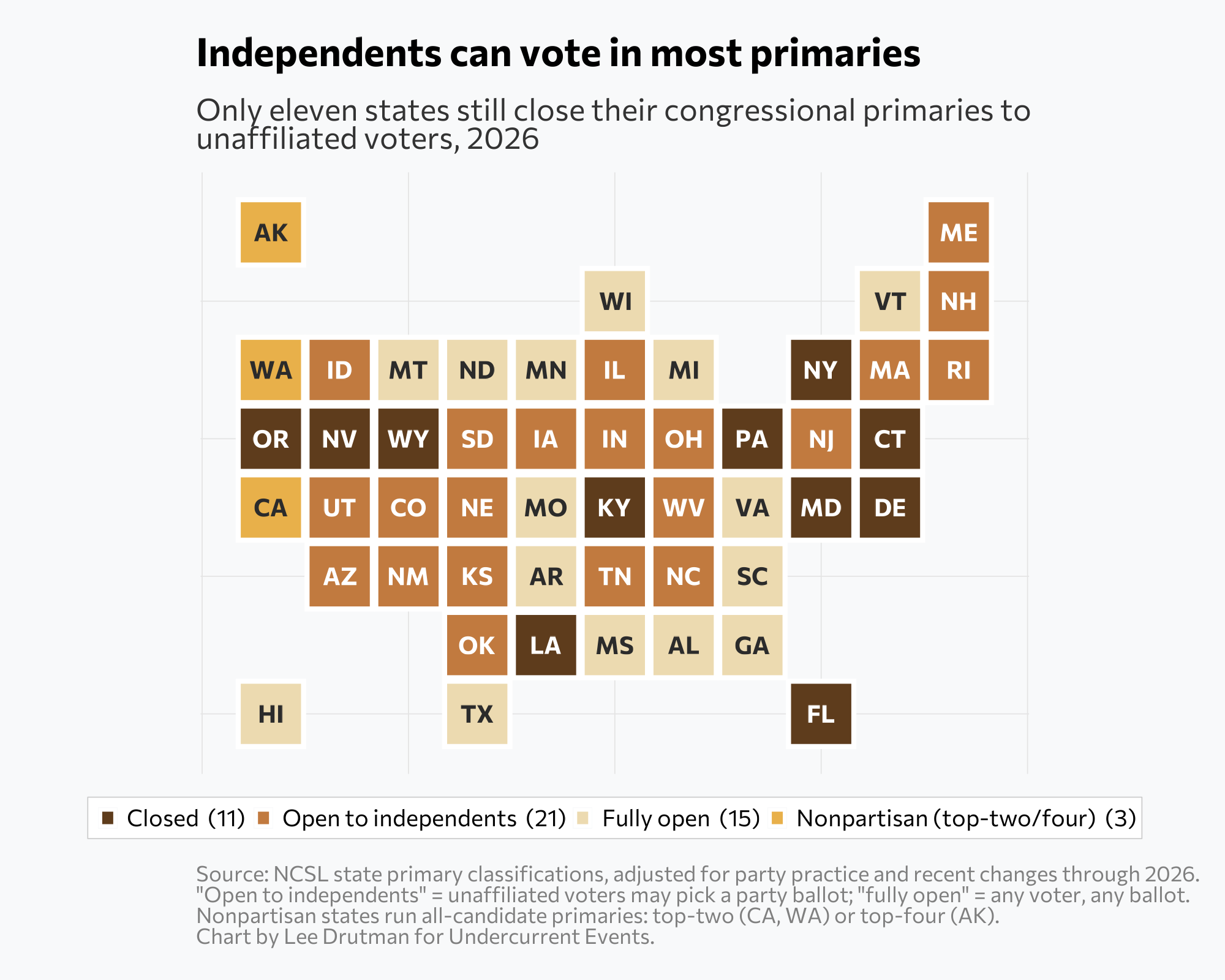
In fifteen fully open states, any voter can take any party’s ballot, so Democrats can vote in Republican primaries and Republicans in Democratic ones.
Another twenty-one let independents pick a party ballot while keeping registered partisans in their own lane. We’ll call these states “open to independents.”
Three states run nonpartisan all-candidate primaries, where everyone runs on one ballot: California and Washington send the top two to November, Alaska the top four. Louisiana used to have a version of this “jungle primary” system, but moved to a closed primary for its most recent election.
That leaves only eleven genuinely closed states, where you have to be a registered Democrat or Republican to vote in that party’s contest.
The diversity of primary type lets political scientists ask the question directly: do the primary rules matter for the types of outcomes we care about, particularly who gets elected?
Short answer: No.
A few years back, I published a deep dive report on the effects of primary type on who got elected. Study after study after study poured cold water on the hope that primary reform is a meaningful lever. Open, closed, semi-open, semi-closed, top-two? No difference in who wins, no difference in how they govern once they get there. And regardless of who is allowed to vote, voter turnout rarely exceeds 20 percent.
However, a lot of these studies test the “moderation” hypothesis, that open primaries sustain more moderate representatives (at least as judged by their voting records). They don’t. But perhaps that’s not the right thing to test.
So, I decided to look at some different outcomes, and particularly among Republicans. A lot of the recent commentary argues that Republican electeds might be more free to challenge Trump if they were appealing to more than just registered Republicans. This is, as we say in the social sciences, a “testable hypothesis.”
This is a hard proposition to test with the current Congress because very few Republicans are breaking with Trump, and Congress isn’t doing much of anything. So I went back to his first term, the 115th and 116th Congresses. If primary type was going to matter, it would presumably matter in the years when there were still some Trump-skeptical Republicans.
It doesn’t. Among House Republicans in 2017–2020, the average Trump-alignment score barely moves across primary systems: 90 percent in closed-primary states, 92 in semi-open, 93 in open, 93 in top-two. If anything, open-primary Republicans came out slightly more loyal to Trump than closed-primary ones, not less. Adjust for how Republican each district already leans, and the tilt holds: about two points more loyal in the open-primary states.1
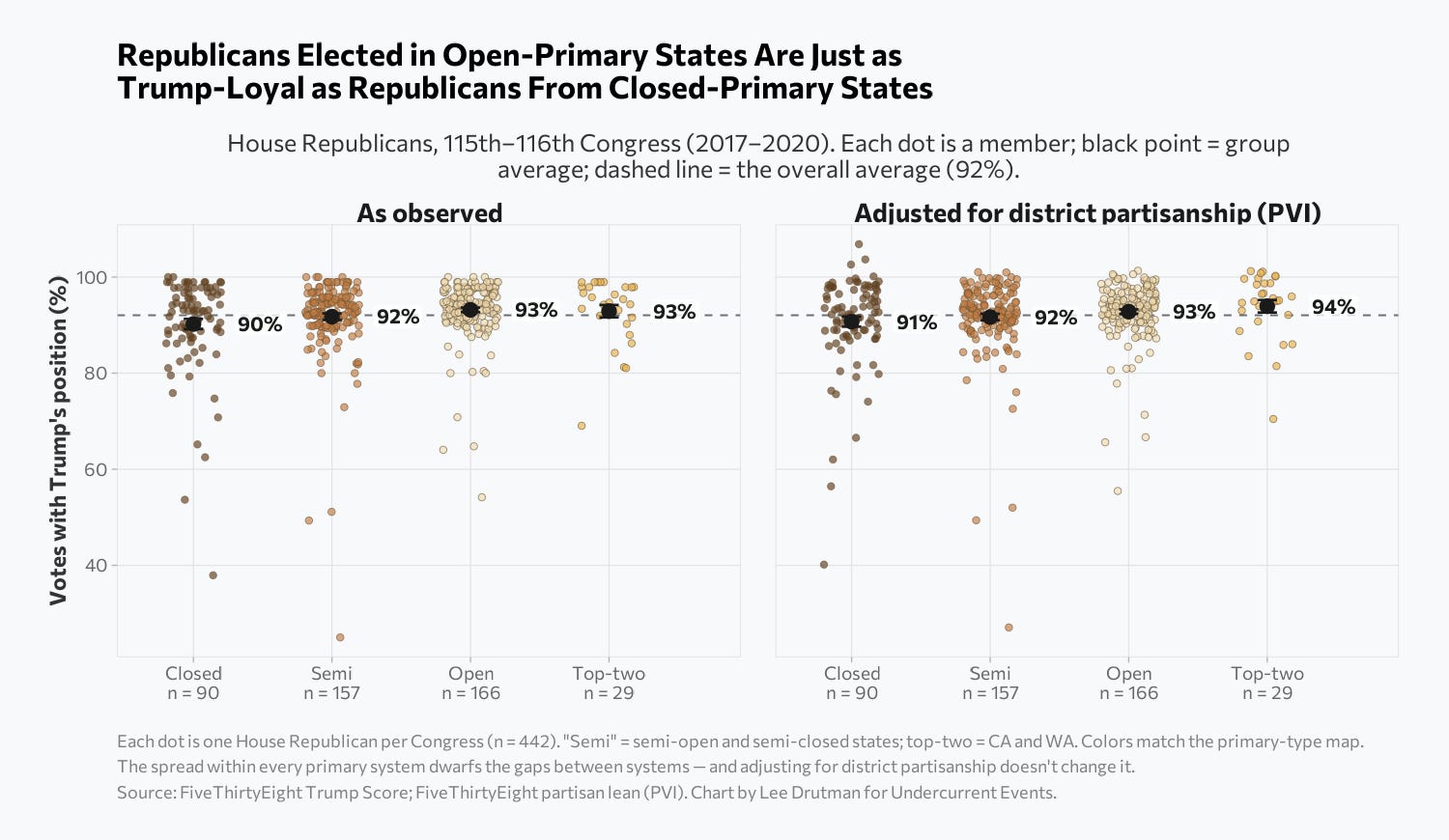
Of course, these are small differences. The major issue is just that the Republican Party is much more homogeneous now than ever. And that’s because Republicans only get elected in the most conservative parts of the country (there are almost no Republicans elected from the Northeast). Which is a function, yes, you guessed it, of our system of single-winner districts.
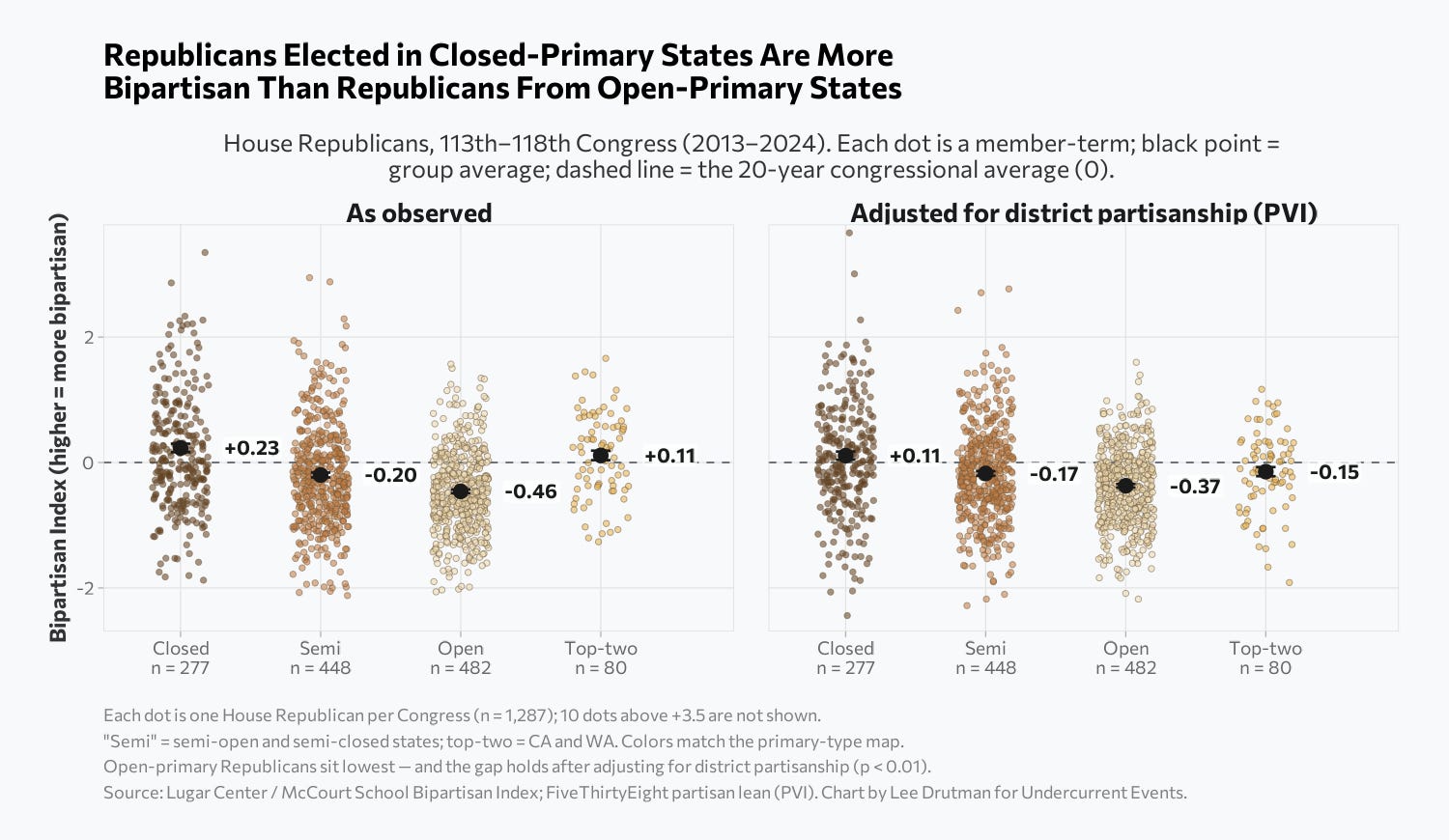
Okay, you might say, votes are a limited measure. What about bipartisanship, as measured by bill cosponsorship? Okay, let’s give that a whirl, using the Lugar Center’s bipartisanship scores.2
If the theory holds, open-primary Republicans should be the ones reaching across the aisle. They’re the opposite. They’re the least bipartisan of the bunch. Closed-primary Republicans score highest on cross-party cosponsorship; open-primary Republicans score lowest.
And what about voluntary retirements? The most bipartisan Republicans, the genuine cross-aisle dealmakers, did leave at notably higher rates during his first term.
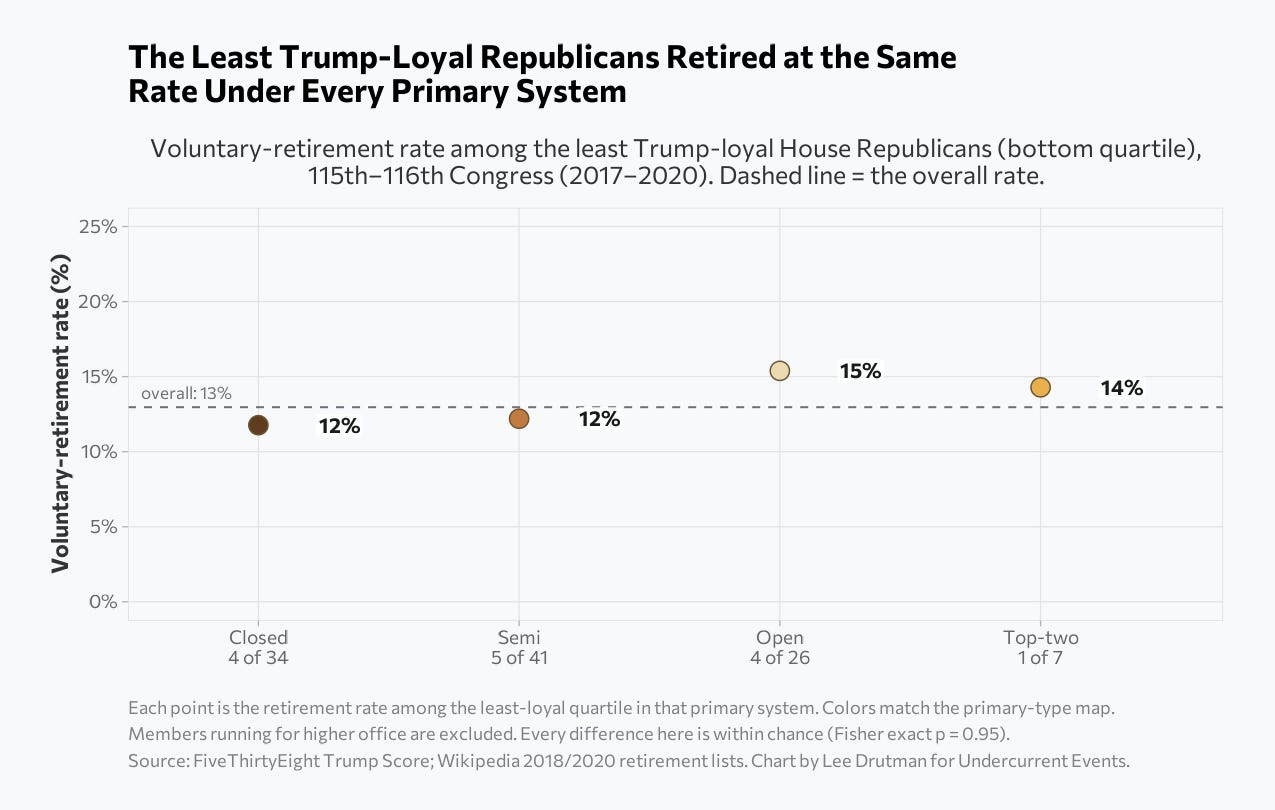
But primary type had nothing to do with who left. Compromise-oriented Republicans walked away at about the same rate whether they sat in a closed-primary state or a wide-open one. This wasn’t their party anymore, so they left. Maybe they feared a loss, either in the primary or the general election. But facing a closed primary compared to an open one didn’t make a difference.
I also ran these tests separately for senators and for Democrats. I didn’t find any consistent effect of primary type anywhere.
Of course, this is one analysis, published on Substack. But again, peer-reviewed top-tier journal study after study after study after study after study after study finds the same null effect for primary type.
And yes, the field has gotten crowded with many studies, including many studies funded by advocates. And yes, if you want to find a glint of a marginal effect, you can self-publish, or find a lower-tier journal to publish in. I reviewed at least one of the lower-tier publications as cranky reviewer 2 and pointed out a list of methodological flaws. The article got published anyway.
But the overwhelming preponderance of independent evidence published in top-tier journals is not ambiguous. The serious science comes down on the side of no effect. So, if somebody feeds you a single study saying they found an effect, ask for a meta-analysis. And if they tell you not to trust the meta-analysis because the published academics are missing something, ask them to explain how and why.
The mistaken assumptions behind “the folk theory of primary reform”
There is what I will call “the folk theory of primary reform.” It is built on a few assumptions, each of which has just enough of a sliver of oomph to make the theory feel plausible: that primary electorates are ideologically extreme and drag candidates to the fringe; that independent voters are moderate and would pull them back; and that incumbents are hostage to a tiny, partisan primary electorate.
The folk image of the primary electorate is the small, angry, partisan “base,” turning out to punish any candidate who isn’t pure enough, while the “sensible” majority stays home. Open the primary, let the sensible majority in, and the fever breaks. Or something like that.
So, first on primary voters as unrepresentative: The best evidence finds that primary voters look pretty much like the broader party’s voters, though probably more consistently partisan, more politically informed, wealthier, more educated, and older than the typical voter.
To the claim that partisan voters are more ideologically extreme, the answer is probably, maybe a little, on the margins, but not nearly as much as the conventional wisdom makes them out to be. The broader electorate is also quite polarized.
What about the claim that “Independent” voters are moderate? Sorry. That one doesn’t check out. The overlap between independent and moderate is much weaker than the conventional wisdom suggests. Many independents are dissatisfied because the parties are too moderate, not too extreme. And they mostly don’t vote in primaries even when they are allowed to.
The third aspect of the folk theory is that incumbents mostly fear primary challengers, and low-turnout primaries make them vulnerable. It is true that they do fear primary challengers. But perhaps irrationally so, since only a handful of incumbents lose their primaries each year. Still, those are the high-profile losses that loom large, so they drive the narrative.
Certainly, it is easy to tell just-so stories about individual candidates and argue that primary rules mattered in single cases.
When Louisiana Senator Bill Cassidy goes down in a closed primary he spent a year denouncing, the tempting reading is that the closed primary did it. Maybe it nudged the odds. But the man was already censured by his own state party, hunted by a president he had voted to convict, and crosswise with the anti-vaccine crowd on top of it. Hand him back the old jungle primary (which he last won in 2020 as a loyal Trump ally with no serious challenger, before the impeachment vote that turned his own party against him) and he still has to finish second, which means Louisiana Democrats have to abandon their own candidate and adopt him in all but name. Was that really going to happen?
Did Lisa Murkowski only survive because of Alaska’s system? Maybe. Or maybe not. She won three times under the old system, including once as a write-in candidate after she lost the Republican primary. She probably could have won as an Independent in 2022 with crossover support from Democrats and some Republicans. But we’ll never know, because that was the year Alaska moved to its top four plus RCV system.
Counterfactual reasoning is hard. The problem is that proving one case is a very different thing than proving a general principle. Yes, where there are only a few cases, it can be valuable. But it demands rigor and realism.3 [4]
The infinite regress problem of candidate selection
Every version of primary reform is trying to solve the same problem: find the one person who best represents the district. Open primaries, top-two, top-four with ranked choice voting, even Condorcet methods that identify whoever beats every rival head to head. They agree about the goal. Locate the center. Elect whoever stands there.
The instinct is logical. When your representative seems captured by a faction, the obvious diagnosis is that the selection process was too narrow. So you open it. When opening it doesn’t work, you open it further. When that doesn’t work, you redesign the ballot. Each step is more sophisticated than the last. Each step assumes the same thing: that the right selection mechanism will surface the right person.
Here is the deeper problem. A district of 760,000 people does not have an obvious single representative. It has a diversity of communities and interests and people. The median voter is a theoretical abstraction in a high-dimensional issue space, and the dimensionality increases the closer one gets to the center. The quest for a single representative at the center reifies the flattening of our politics into a single dimension, which is the reason we are in this mess, according to my analysis.
Further opening the process does not solve this problem.
By world standards, American primaries are extraordinarily open. In most democracies, nominees are chosen by dues-paying party members, delegates, or the leadership itself.4 The public gets no vote. When someone here says “open the primaries,” they are asking to further open the most open nominating system that has ever existed.
At some point, however, somebody has to narrow the field. If it’s not the parties, then it’s the candidates self-selecting, mostly based on who can raise enough money or who has enough name recognition. Hundreds of thousands of voters do not spontaneously converge on an ideal candidate. They can only choose among the candidates who decide to run because they can, thanks to the support of other people or their own ginormous bank account. There is no magical point where “voters” finally get to decide. Somebody has to give them a choice by narrowing the field and focusing attention on candidates who can actually win.
Proportional representation escapes this infinite regress by rejecting its premise. It does not try to find the one best representative. In a five-member district, the factions do not have to destroy each other for the right to be the district’s sole face. They compete in the general election, in front of everyone, and win seats in proportion to their actual support. The current intra-party argument moves from the smallest electorate to the largest one, which is where an argument about who represents us belongs.
Democratic progressives and moderates may belong in the same governing coalition, but they don’t belong in the same party. They should argue their differences in the general election, not the primary, and see who gets to send more representatives to Congress. Similarly, traditional Republicans and MAGAheads should do the same. Let them all get some representation, in proportion to their support. That’s proportional representation, folks.
For offices that are inherently single-winner (governors, senators, presidents), fusion voting does the analogous work. Factions get their own ballot line, their support gets counted in public, and coalitions get assembled in November rather than erased in April.
The transformative thing
I imagine an advocate of primary reform reading this and telling me that primary reform might not be perfect, but it is the achievable thing. Whereas my proposed reform, proportional representation with fusion voting for inherently single-winner elections, is too radical a change.
Two years ago, reform advocates put versions of open primaries on the ballot in seven states.5 [3] All seven lost. So if the argument is that primary reform is the achievable thing, and it then loses everywhere it appears, it may not be the achievable thing its advocates say it is.
As I argued then, and still argue now, the primary reforms on the ballot in 2024 fell into a weird dead zone, where they were not transformative enough to genuinely excite voters into learning more about them, but were also seen as enough of a change that they provoked some genuine skepticism. You can’t sell a reform and promise voters that it is transformative and then tell incumbent politicians: don’t worry, it’s actually not that transformative, it’s just a minor change. Only one of those things can be true. In the case of primary reform, the second one was more true than the first. It was a minor reform. But it was marketed as a transformative one, which confused everybody, because it wasn’t.
Proportional representation is the transformative reform that fixes the issues that voters actually care about: uncompetitive districts, gerrymandering, and a two-party squeeze that leaves most voters choosing the lesser evil. Open primaries touch none of them, because they operate one level below the thing that’s broken. If we’re going to actually try to solve the core problems, then let’s do the thing that solves the core problems.
But something fundamental changed in the last year, and it’s opened a much wider aperture and appetite for reform.
In the summer of 2025, at President Trump’s urging, Texas Governor Greg Abbott called a special session to redraw the state’s congressional map mid-decade, aiming to flip five Democratic seats before the 2026 midterms. The Supreme Court let it stand. California drew retaliatory maps. Missouri, North Carolina, Ohio, and Utah followed. By early 2026, six states had entirely new congressional maps, drawn not after a census but after a political calculation. The new mid-decade redistricting arms race was on.
The second blow was Callais. On April 29, 2026, the Supreme Court gutted Section 2 of the Voting Rights Act, the last meaningful federal constraint on how states draw districts. The Rucho decision in 2019 had declared partisan gerrymandering beyond the reach of federal courts. Callais finished the job on the racial side. Republican states throughout the South raced to wipe Black Democratic seats off the literal map. The gerrymandering arms race is turning into an extinction event for competitive districts.
A primary reformer might say that the gerrymandering wars prove their point. If general elections are now foregone conclusions almost everywhere, then the primary really is the only election that matters, so the primary is exactly where reform belongs.
Except the primary is only “the election that matters” because single-member districts made November a foregone conclusion. But remember what I told you earlier: primary elections are rarely competitive either. And “opening the primary” still assumes one person can represent the whole district, which is the premise that got us here. It also ignores the problem that somewhere, politics needs gatekeepers. Better to see the gatekeepers than to push them into the shadows, as nonpartisan primaries effectively do.
I am not arguing that PR is easier to enact. It isn’t.
But the conversation on proportional representation has moved into the mainstream. When the New York Times devotes an hour of the Ezra Klein Show to proportional representation as the answer to the gerrymandering doom loop, something has shifted. (And yes, I was the guest.)
Reform windows do not stay open forever. The appetite for genuine structural change that exists in this political moment is not a permanent feature of the landscape. Spend it on a reform that doesn’t fix the core problem, and you waste the window on a marginal reform. And marginal reforms deliver marginal results.
The bold thing is far away only as long as we keep deciding it is.
If open primaries appealed to you, you already believe the heart of this argument. You believe every voter, regardless of party registration, deserves a real say in the election that matters. Keep the instinct. Upgrade the reform.
We have a chance to do the thing that actually matters. So, let’s do it. Let’s give every American a meaningful vote in the November elections. Let’s enact proportional representation everywhere.
Trump-alignment figures are FiveThirtyEight’s Trump Score for the 115th and 116th Congresses (2017–2020). The interactive tracker now redirects into ABC News and is no longer updated; the underlying data remain at https://github.com/fivethirtyeight/data/tree/master/congress-trump-score. District-partisanship adjustments use FiveThirtyEight’s partisan-lean measure.
Bipartisanship figures are the Lugar Center / McCourt School Bipartisan Index, based on bill sponsorship and cosponsorship, 113th through 118th Congresses: https://www.thelugarcenter.org/ourwork-Bipartisan-Index.html
Could World War I have been avoided if Archduke Franz Ferdinand had not been shot in Sarajevo? Maybe. Maybe not. But notice why nobody seriously proposes preserving peace by better security for archdukes. The assassination was a trigger, not a cause. What we can point to and what actually did the work are rarely the same thing.
The best comparative treatment is Reuven Hazan and Gideon Rahat, Democracy within Parties: Candidate Selection Methods and Their Political Consequences (Oxford University Press, 2010). In most parliamentary democracies, the selectorate — the group empowered to choose nominees — ranges from the party leadership to dues-paying members. Public primaries of the American type are the global outlier.
Arizona voted on an open primary and Montana on a top-four primary, neither bundled with ranked choice voting. South Dakota voted on a top-two. Colorado and Idaho paired a top-four primary with ranked choice voting, and Nevada a top-five. Oregon voted on statewide ranked choice voting for primary and general elections. All results: https://ballotpedia.org/Results_for_ranked-choice_voting_(RCV)_and_electoral_system_ballot_measures,_2024
Is H.R.4632 - Fair Representation Act the only piece proportional representation legislation currently in U.S. Congress? Does it have any chance of passage without a trifecta flip and filibuster proof Senate?
Great article. My understanding is you no longer favor the Fair Representation Act? I am wondering if there is a new bill in the works by reformers? For activists and organizations trying to support proportional representation it is really important to have a concrete bill to point to when building support. The urgency is here, 2029 might be the one shot in years — even if it's a long shot.