

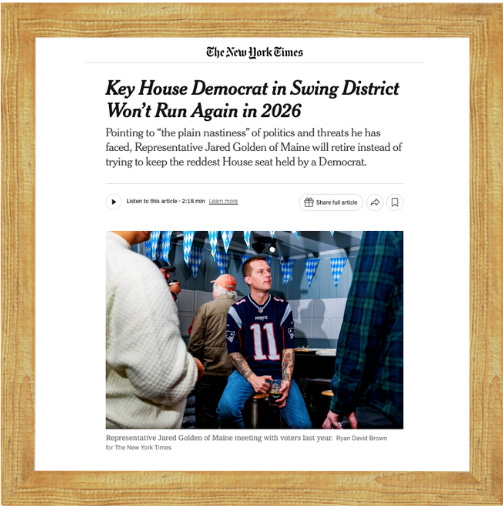
What happens to politicians who understand the system is broken but lack the votes to fix it?
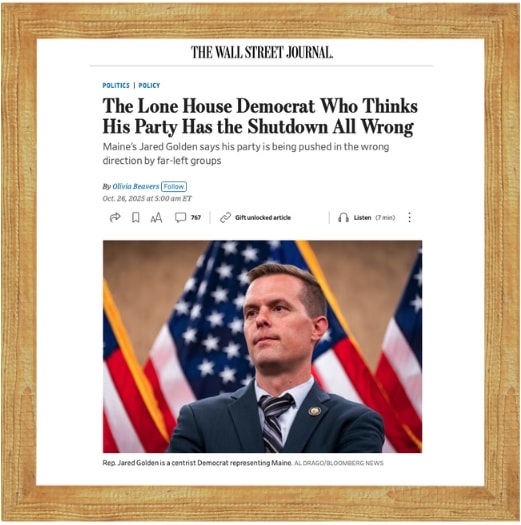
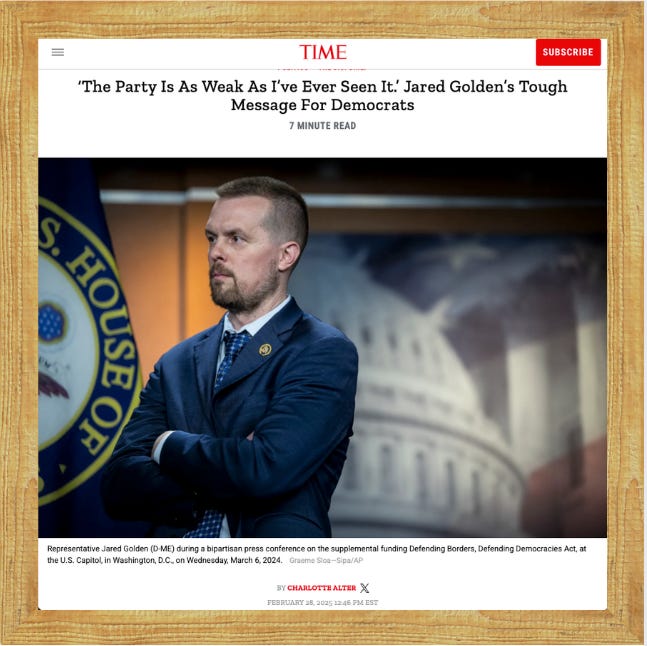
Jared Golden won Maine’s Trump-supporting district four times—a rare feat that earned him acclaim as a generational political talent others should study and emulate.
This week he announced he won’t run again. Bomb threats sent his family to a hotel last Thanksgiving.
I get it. I would not want to receive bomb threats, either. I’m a parent too.
Earlier this year, Golden tried to do something about the problem of a broken political system. He and fellow Blue Dog Democrat Marie Gluesenkamp Perez introduced legislation to create a Select Committee on Electoral Reform to study multimember districts, proportional representation, and House expansion, among other ideas.
This is how I know the congressman—as a reformer. I’ve talked with Golden and his staff about these reforms. His interest is genuine and deep.
Golden got it. Our electoral rules are obsolete. He understood why representatives who don’t fit easily into either party are so rare: the electoral system works against them. Our electoral system is winner-take-all, which means in today’s nationalized politics, it flattens every district into a partisan monoculture—exactly the opposite of the pluralism necessary for American democracy to function.
Congress keeps losing the people who want to fix it. Which makes it worse. Which breeds more violence. Which drives out more reformers. What breaks the cycle? How does this get better?
Congress is losing the people it needs most
Golden joins 31 House members and 8 senators who aren’t seeking reelection this cycle. So far. And that’s already an unusually high number for this point in the cycle.
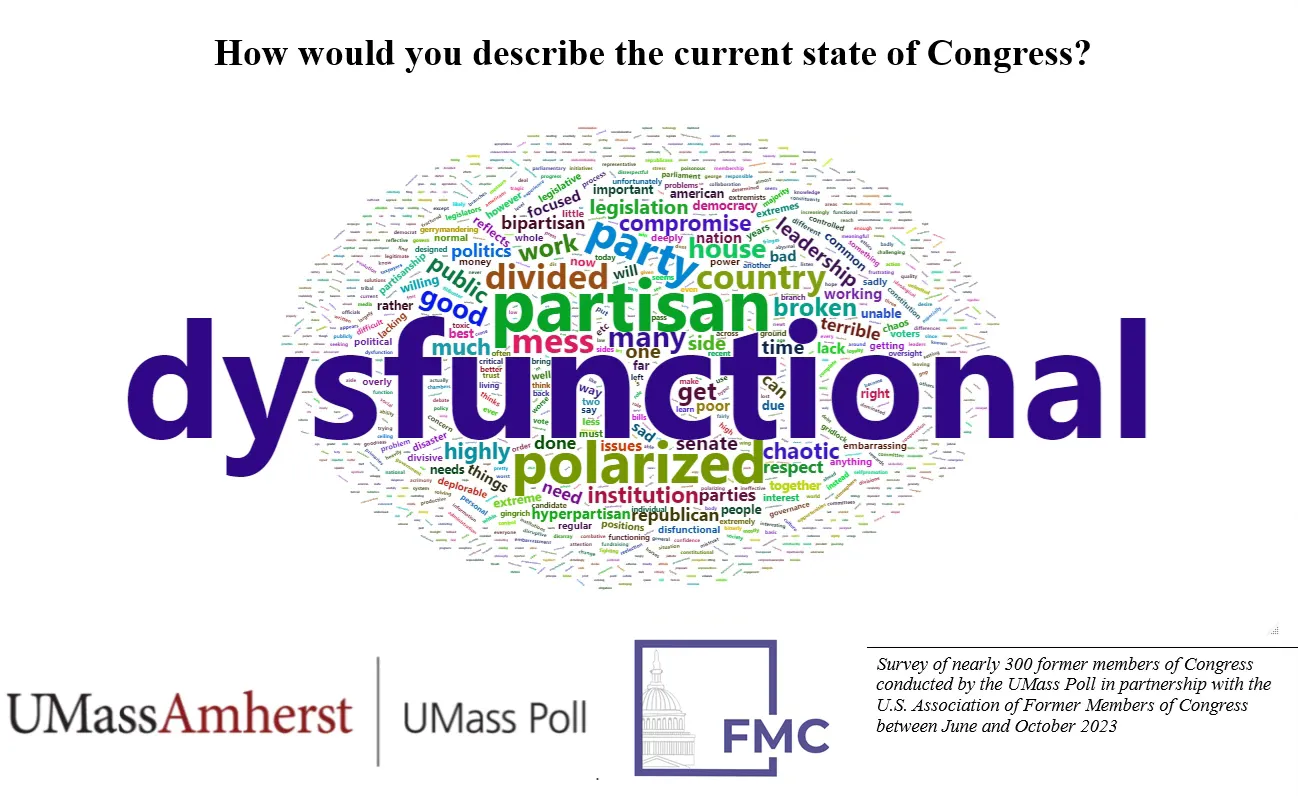
This isn’t new. Two years ago I catalogued the early departures of problem-solving members from the previous Congress. I also highlighted a survey of 300 former members. And one word dominated their responses when describing Congress’s current state: “dysfunctional.” No wonder so many good folks are saying goodbye.
The job is hard. Constant travel and time away from family. Endless fundraising. Ceaseless media scrutiny. And increasingly, threats to personal safety and family.
These threats are what made Golden reconsider his current position. As he wrote:
“I have grown tired of the increasing incivility and plain nastiness that are now common from some elements of our American community — behavior that, too often, our political leaders exhibit themselves. My team and I have strived to stay above the fray and, for that, we can hold our heads high with appreciation for each other and the way we have gone about our work.
Additionally, recent incidents of political violence have made me reassess the frequent threats against me and my family. Last year we saw attempts against Donald Trump’s life, and more recently we witnessed the firebombing of Pennsylvania Gov. Josh Shapiro’s home, the assassination of Democratic lawmakers in Minnesota and the horrific murder of Charlie Kirk.
These have made me reconsider the experiences of my own family, including all of us sitting in a hotel room on Thanksgiving last year after yet another threat against our home. There have been enough of those over the years to demand my attention.”
Half of former members in the survey experienced treats against them personally or against their families. A third said staff were threatened. Among women and members of color, 70% reported personal or family threats, nearly half reported staff threats.
The moderation debate is missing the bigger picture. Nationalization is eating moderation and polarization is driving moderates away.
Golden’s departure comes amid a heated debate among Democratic analysts over the value of moderation.
I weighed in last week. I argued that our polarized nationalized politics is flattening moderation’s value into statistical nothingness. I argued that instead of debating one or two percentage points, we should expand the dimensionality of politics to make factors beyond D vs R relevant again.
Two charts tell the story. Senate elections from 2000-2024 show declining variability. House elections from 2016-2024 show the same pattern.
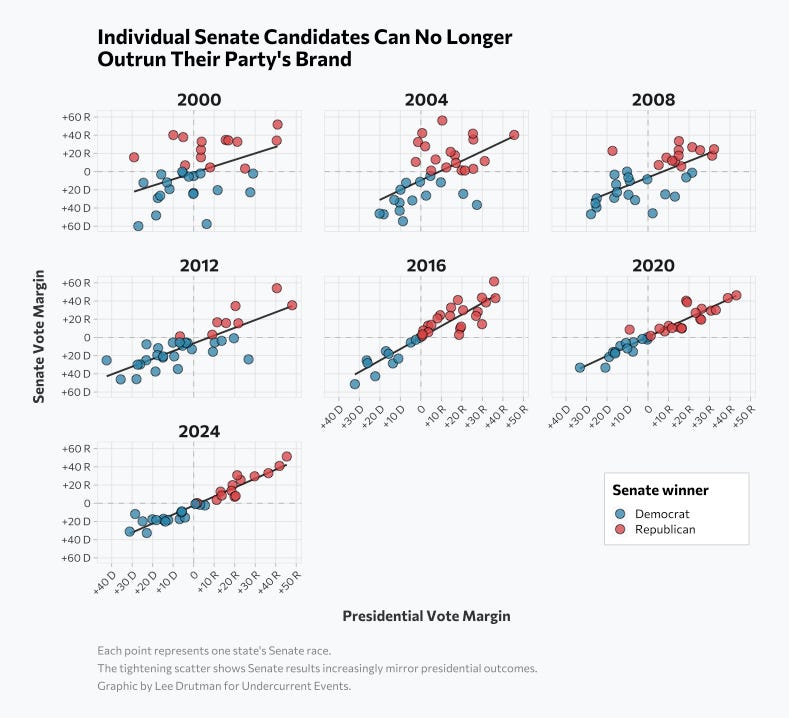
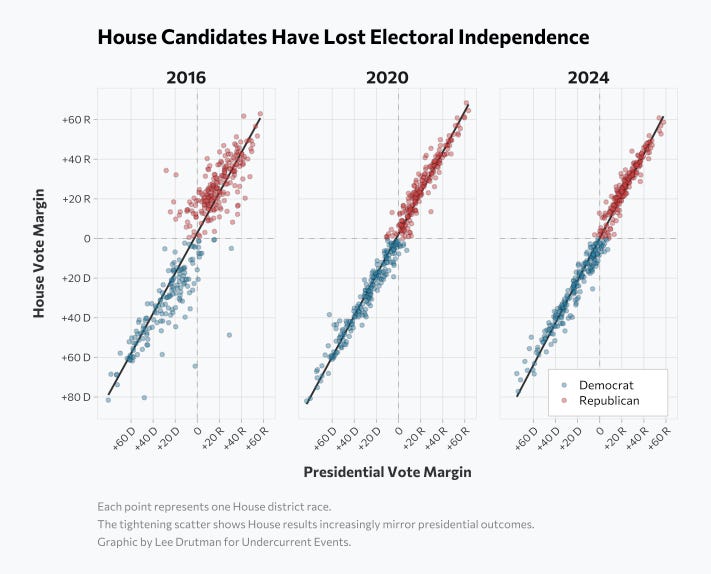
Presidential vote share now dominates down-ballot races. Straight-ticket voting is crushing individual candidate effects. Golden was a rare exception. He distinguished himself by sending costly signals of independence—including a Bangor Daily News op-ed saying Trump was going to win and democracy would be fine. Bold move in a Trump district. It worked. Not many Democrats can credibly pull that off.
When moderates like Golden move on, who replaces them? Fewer and fewer moderates want to run for national partisan office these days.
After all, if you’re a moderate, where do you fit? Golden was often at odds with his party. He’s a mature adult, for sure—but I imagine even mature adults tire of swimming against their own party’s current.
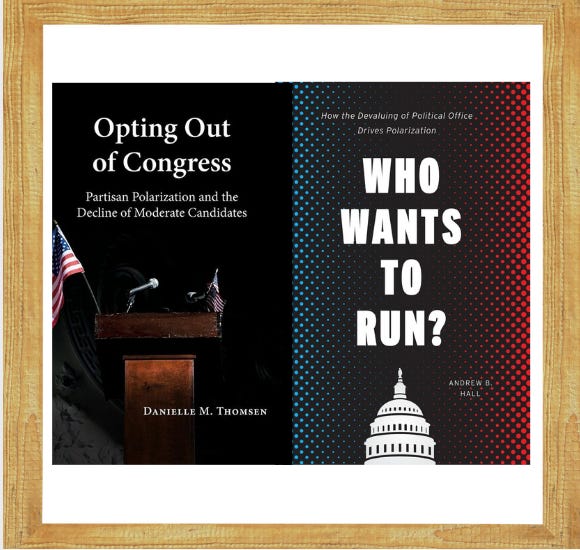
Here, I want to draw attention to an important 2017 book: Danielle Thomsen’s Opting Out of Congress: Partisan Polarization and the Decline of Moderate Candidates.
Political moderates “opt out,” Thomsen argues, because they envision what Congress would be like for them: isolated and constantly frustrating.
Thomsen calls this “party fit”—the simple idea that people are more likely to run for Congress if they can actually see themselves fitting in with their party caucus. If they can’t? Most won’t bother.
Thomsen conducted wide-ranging interviews in 2013, mostly with moderate members. Here’s a paragraph from her book (page 42, for those following along at home) that strings together some insightful quotes.
Many of these members, particularly moderate Republicans, spoke at length about how the job itself became “frustrating,” “unsatisfying,” and “increasingly confrontational” (14 January 2013; 25 January 2013). A moderate Democrat who retired added that it was “no longer as much fun” (25 January 2013). One Republican groaned, “Everything was a fight,” and likened his experiences to “those clown things you punch” (22 January 2013). These day-to-day struggles did wear on members: “Every day going in and being the odd man out . . . It’s grueling; it’s exhausting; it’s corrosive” (22 January 2013). Another said, “It’s not fun anymore. Your job is not supposed to be fun like going to an amusement park, but it should be pleasant. Members are saying it’s not pleasant anymore. Legislators now have such intense feelings. You’re viewed like a heretic by people who have a different point of view than you. That’s not very good, not very healthy for the republic” (14 January 2013).”
But that was 2013. Since then, the moderate exodus has only accelerated, making party caucuses more homogeneous and the experience for any remaining moderates even more isolating.
Andrew B. Hall reached the same conclusion in his 2019 book, Who Wants to Run?: How the Devaluing of Political Office Drives Polarization. Hall focuses on the cost-benefit calculation. Add up all the difficulties—the fundraising, the campaign gauntlet, the time away from family, and increasingly, the threats —and you’ve got a cost-benefit analysis that tips towards conflict-seeking partisans and discourages compromise-oriented moderates. Or, in Hall’s more dispassionate academic phrasing: “when costs of running are high or benefits of holding office are low, more moderate candidates are disproportionately less likely to run.”
And so the doom loop spins further: fewer moderates running means more polarized parties, which means even fewer moderates wanting to run. Asking would-be moderates to enthusiastically pursue careers in perpetual party misfit status seems...optimistic?
The fix, then, isn’t recruiting braver moderates. It’s changing the system that grinds them down. Which brings us back to Golden and that select committee resolution.
What will it take for Congress to take this problem more seriously?
In my recent piece on the collapse of electoral dimensionality, I argued fusion voting restore some lost dimensionality and electoral competition. Competitive districts like ME-2 encourage candidates to adopt more “moderate” winning strategies. And competition is a good in and of itself.
Even more transformational change would come with proportional representation. Under PR, populist moderates like Golden wouldn’t need to fit into the Democratic Party. They’d could run under their own distinct party banner and with like-minded misfits-no-longer. And they could win seats in proportion to their share of votes without having to be a majority in any single geographic district.
Golden understood this. He knows single-member districts undermine the pluralism necessary for folks like him to win a seat in Congress. That’s why he was exploring electoral reform.
In their case for the select committee, Golden and Gluesenkamp Perez invoked founding principles: “Our nation’s founders understood our democracy is a work in progress.”
Almost 200 democracy scholars backed the proposal. The Scholars for Electoral Reform group writing in support made the stakes clear:
“Not since the Civil War era has polarization in America reached such concerning heights. Increasingly, Americans see the opposite party as not merely in competition with them, but as a threat to their very existence.
Worsening this crisis is America’s outdated electoral system, which promotes an “us” versus “them” approach to politics. We call on Congress to support the Resolution to Establish the Select Committee on Electoral Reform, which would bring together a bipartisan group of Members of Congress to study and make recommendations for reform.
Every generation, Americans develop new ideas to modernize our political institutions — so that they provide a place to constructively work out our differences, not further divide us.
We urge Congress to take this step towards reversing today’s dangerous levels of polarization and dysfunction, and to strengthen itself as the fulcrum of our democracy.”
Of course, the committee hasn’t been created yet. No Republican has been willing to sign on. And Democratic leaders have not expressed much interest.
Is Congress too broken to even examine how it broke?
The Golden hour is fading into the sunset
Jared Golden is unique. Who replaces him?
Right now, a talented Democratic state legislator is reading about Golden’s retirement. She’s in touch with her constituents and often at odds with her party. She might win in a Trump +5 district. She understands electoral reform. She’s exactly what our democracy needs.
But she’s also a parent. She’s thinking about Thanksgiving in a hotel room. She’s thinking about her daughter starting school.
What do we tell her?
Ironically Golden benefited from the 1 (flawed) election reform we use to prove incentives for moderates to win: RCV
It is tremendously depressing for the Democratic Party to not support Golden and Glusencamp Perez wholeheartedly. They are the best candidates the party could find. It will be either them or a Joe Kent type, a MAGA conspiracy theorist who plays footsie with white nationalists. Can people not understand their own dogma may not work for certain states and districts?