

(Editor’s note: This piece is adapted from my 2021 report on redistricting)
The gerrymandering wars of the late 2020s are ugly ugly ugly. Maximum warfare. Total Gerrymaxxing. Demockracy, pronounced with the emphasis on the mock.
Gerrymandering in America is as old as the republic. It’s never been this bad. But it’s never been good either.
At no moment in American history has our winner-take-all districting system worked particularly well. There is no golden age of “fair districts.”
The problems have been different at different times. But the antiquated voting system that produces them has been there from the start.
So, for those who like to know their history, I see you. This piece is for you. And for the rest of you, a little history helps explain a lot. Stick with me.
And for those who still want just an explainer on what the heck gerrymandering is, I’ve got you too, and in two flavors, Socratic dialogue form, or attempted board game analogy
Onto the history!
1789–1840: Problematic from the creation
The Framers didn’t spend much time debating how to elect members of Congress. There wasn’t much to debate. In 1789, there was essentially one model of legislative elections in the world: you drew geographic boundaries, and whoever got the most votes in each place won. Party-based proportional representation wasn't invented yet.
The Framers didn’t choose winner-take-all. They inherited it, the way you would have inherited your grandparents’ rope bed if you were around in 1789, because it was the only bed available. But the ropes require constant tightening and fray over time. No wonder we’re losing sleep over our democracy.
What the Framers did debate was how many seats each state would get in the House of Representatives. Their answer was proportional representation. That is, seats allocated to states in direct proportion to state population. Proportional representation is a bedrock American idea. We just never applied it to parties.
By the third Congress, the U.S. was using Thomas Jefferson’s original divisor method to allocate seats. A century later (1899), Belgium adopted the identical formula for party-based proportional representation and called it D’Hondt. (Some Belgian dude, apparently. Americans never get any credit.)
The original formula was set at one representative per 30,000 constituents. Virginia, the biggest state, got 10 representatives. Massachusetts and Pennsylvania each had eight. Two states wound up with a single representative: Delaware and Rhode Island.
The Constitution said nothing about how states should actually elect their representatives. Article I, Section 4 left the details to state legislatures, with Congress free to overrule them. Congress didn’t. So states experimented.
Without guidance, states went in all directions. Some elected their representatives statewide, on a “general ticket.” In Pennsylvania, voters got eight votes, one for each seat. Others used districts. A few tried hybrids (Georgia and Maryland elected representatives at large, but required them to reside in specific districts). There was no standard.
Virginia chose districts. That meant drawing lines. Nobody had a good way to do this. Towns and counties were the obvious building blocks, but they didn’t sort themselves into neat equal groups. So state governments improvised, combining and splitting counties to create districts of roughly equal size. Roughly.
That very first election produced the very first gerrymander. Patrick Henry and his Anti-Federalist allies drew the Fifth Congressional District to bury James Madison, packing Madison’s home county of Orange in with counties that had sent Anti-Federalist delegates to the Virginia Ratifying Convention. Henry even pushed through a rule requiring candidates to live in their district for twelve months, so Madison couldn’t escape to friendlier terrain.
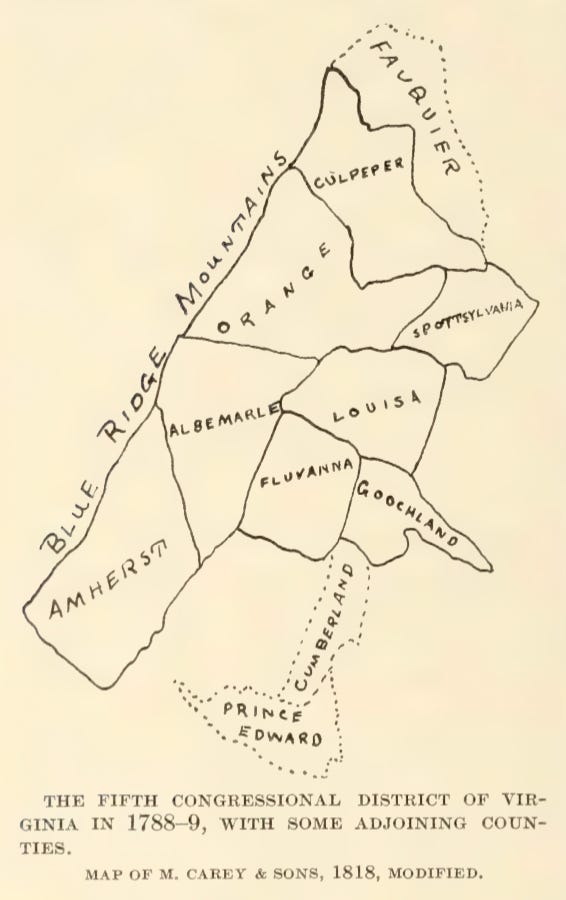
Future president James Monroe was the chosen candidate of the Anti-Federalists. But Madison won anyway, 1,308 votes to 972.
Rather than conceding a safe seat to Monroe, Madison used the competition as a spur. He had to win over skeptical Baptists in hostile territory, which forced him to think seriously about how to win them over. The answer: amending the Constitution to protect religious liberty. A position he had previously opposed. Madison won. Then he went to Congress and drafted the Bill of Rights.
Most gerrymanders don’t backfire this spectacularly. But the accidental lesson of America’s first one still holds: competition is good for politics. Representatives who have to win over skeptical voters might get creative. Sometimes they make better policy. Sometimes they even produce the Bill of Rights. (Though that was kind of a one-off)
So, kids, a fun fact: The first gerrymander failed! But that was before computerized mapping software, voter files, and predictable partisanship. The science was less precise then.
The word “gerrymander” slithered into existence in 1812. Massachusetts Governor Elbridge Gerry — a signer of the Declaration of Independence and later James Madison’s vice president — signed off on a snaking state Senate district designed to secure his party’s seats in the state legislature. A Boston Gazette cartoonist added wings and claws to the district map and christened the sinuous creature a “Gerry-mander.” The name stuck.
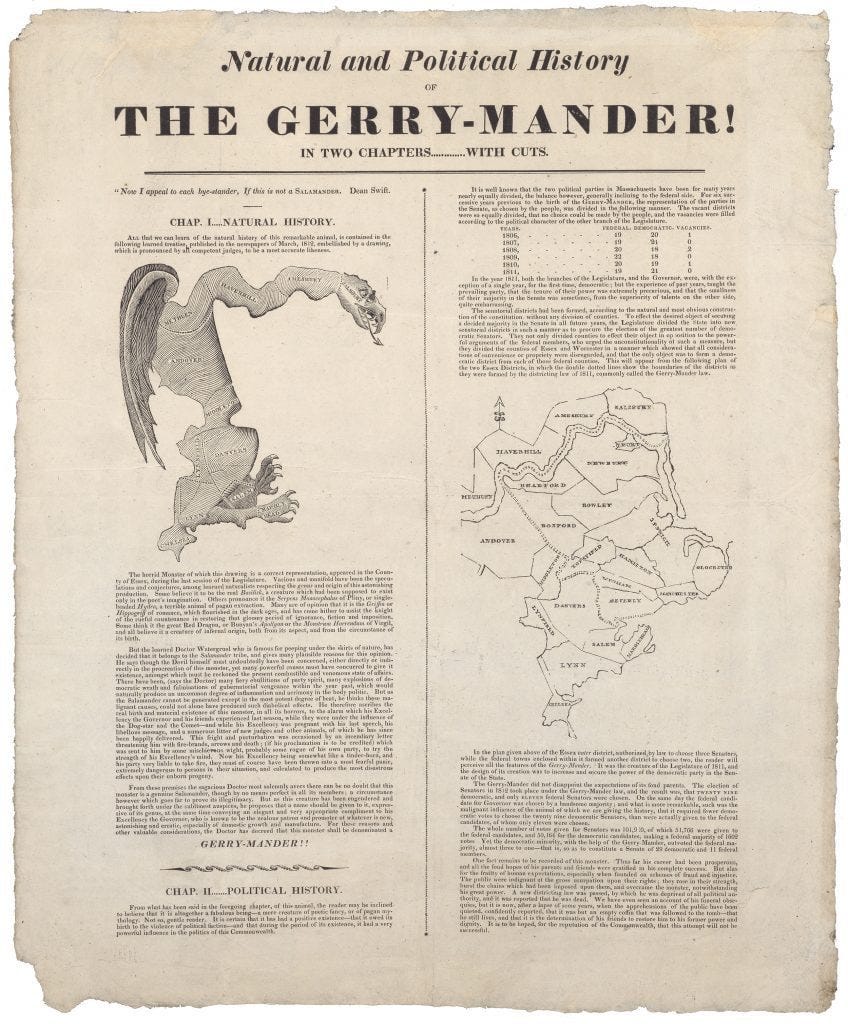
The Gazette essay accompanying the cartoon blamed “many fiery ebullitions of party spirit, many explosions of democratic wrath and fulminations of gubernatorial vengeance within the year past.” They could run it again today without changing a word. (Okay, well maybe update the vocabulary a bit. ebullitions? But the sentiment is evergreen.)
“Cracking and packing” (distributing your voters more efficiently than your opponents) was one tool. The neater gambit was even simpler: just change the system entirely. Win 55 percent statewide? Switch to at-large elections and sweep every seat. Losing ground? Switch back to districts and hold your safe ones.
Consider Pennsylvania. Federalists controlled the legislature and were strongest in Philadelphia, so they imposed statewide at-large elections at the start of the Republic, giving Eastern Pennsylvania supremacy over the whole state. Western Pennsylvania fought back and forced a switch to districts for the 1790 elections. Federalists reverted to statewide in 1792. Districts again in 1794. Whee.
Pennsylvania wasn’t unusual. At any given moment between 1789 and 1840, roughly a quarter of all states allocated their seats statewide. Which states was in constant flux. The same opportunism also jumbled the Electoral College each election. States toggled between district and statewide allocation of presidential electors depending on which party was in power.
1842–1896: The Single-member district becomes dominant
In the 1830s, Democrats had moved aggressively toward statewide elections to entrench their majorities. Then 1840 happened. A bad economy, a popular Whig war hero, and suddenly all those statewide systems were sweeping seats for the other side.
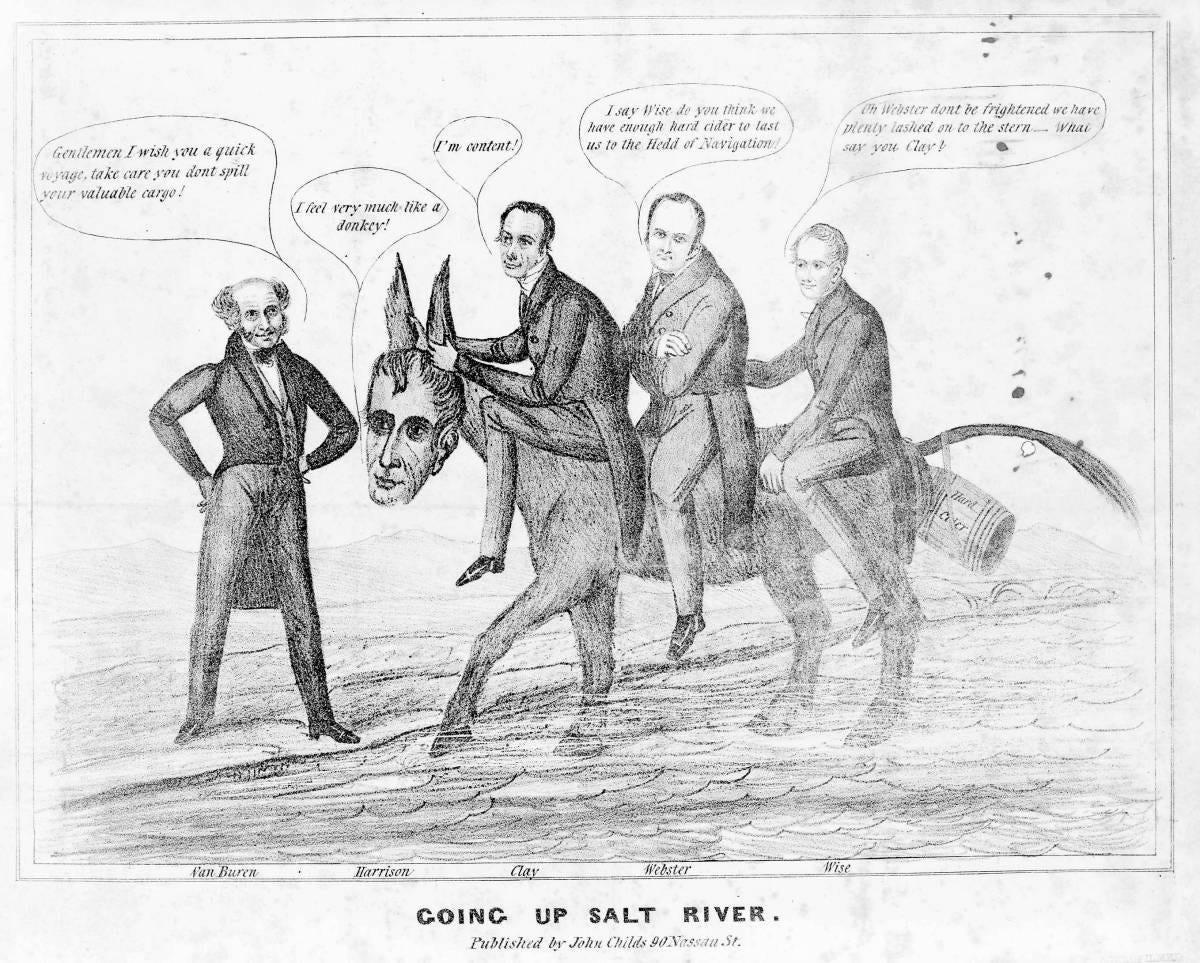
Then newly elected Whig president William Henry Harrison died a month into his presidency, and everything fell apart. His successor John Tyler was a Democrat at heart who went to war with his own party. (It was a classic “Whigs in Disarray” story!)
Facing an inevitable midterm wipeout, the Whigs realized their best hope was preserving safe districts in the areas they’d swept in 1840. Their solution: the 1842 Apportionment Act. It mandated single-member districts nationwide, switched the apportionment formula from Jefferson’s method (which favored large states) to Daniel Webster’s method (which was fairer to small states), and even shrank the House — the only time in American history that’s happened. The Whigs jammed it all through on a largely partisan vote.
(For more on the under-appreciated 1842 Apportionment Act, see my earlier deep dive.)
Whigs lost the House anyway. Not all Democratic states complied immediately. Democrats took back the White House in 1844. But in 1846, when Democrats faced their own predictable midterm reckoning, the holdout Democratic states rushed to adopt single-member districts to protect their safe seats. And so the single-member district locked in. It was more proportional than at-large statewide bloc voting.

Through the 1840s and 1850s, boundary-redrawing was routine. But the real gerrymandering arms race came after Reconstruction, from 1878 through 1896 — a period of close national competition, firm partisan loyalties, and high voter turnout. A bit like today!
This combination was the formula for maximum gerrymandering. When voters are predictable, mapmakers can draw with precision. When elections are close, the stakes of drawing well make majorities. The Gilded Age is full of echoes.
1896–1964: Stasis and malapportionment
Then the competition collapsed. The Election of 1896 cracked American politics into solid regional blocs. Southern Democrats sealed behind Jim Crow, Republicans became dominant throughout the North. Nobody needed to gerrymander anymore — there was no gain. But what followed wasn’t a golden age of fair maps. It was an age of deepening malapportionment.
In Louisiana, Democrats held every single seat in the state legislature from 1900 to 1964. They kept the same congressional map for over fifty years. Why redraw lines that are already producing victories?
Wisconsin redistricted in 1932 and not again until 1962. Illinois redrew in 1902, then not until 1948. Connecticut kept its 1912 boundaries until 1962.
In the 19th century, a congressional district had a 20 percent chance of being redrawn in any given election. In the 20th, the typical district went undisturbed for two decades.
One reason redistricting had kept happening, largely in years ending in “2,” was that Congress kept getting bigger. And every decade, a new census. Every decade, Congress added more seats to keep up with the growing population. This required new district maps.
The 1920 census was the first to confirm that more Americans lived in cities than on farms. Rural members didn’t like what that implied for their seats. So they blocked reapportionment entirely. For the only time in American history, Congress simply pretended the census hadn’t happened.
In 1929, Congress froze the House at 435 members, capping a remarkable expansion from just 65 members in 1789. No new seats meant no new maps. The periodic forced reckoning with population change quietly disappeared.
As Americans moved into cities, district boundaries stayed put. By the early 1960s, the disparities were grotesque. In Georgia, Atlanta’s Fifth Congressional District — drawn in 1931 and then not redrawn for three decades — had 823,680 residents. A rural district in the same state had 272,154. Same state, same Congress, three-to-one ratio. GA-5 was the district John Lewis would later represent for three decades. Before one-person-one-vote, its residents had one-third the voice.
Malapportionment made the House more rural and more conservative than the country it represented, and in both parties. Farm subsidies fattened while school-lunch programs and urban transit support shrank.
Rural representatives held the majorities. They controlled the committees. Why rock the pork barrel?
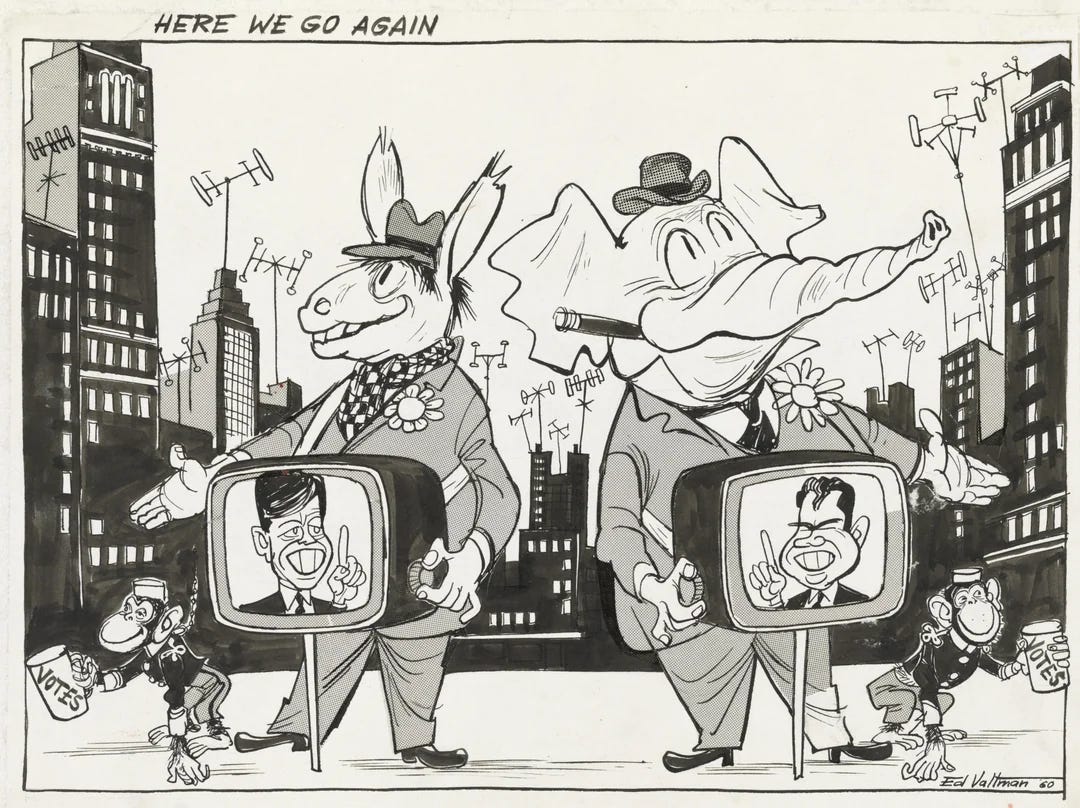
It finally took the courts to require fair representation by population. In Baker v. Carr (1962), the Supreme Court ruled that malapportionment was a problem the judiciary could actually do something about. Two years later, in Reynolds v Sims (1964), it established one-person, one-vote as the standard. States were forced to redraw their maps for the first time in decades. Some for the first time in half a century. The reapportionment revolution followed.
1964–1992: The reapportionment revolution and the new incumbency protection racket
What followed was a major redrawing of maps. The rebalancing shifted power toward cities. Urban Democrats gained seats. More districts could now elect a Black representative. The House started to look a little more like the country.
In 1967, Congress doubled down on the single-member district, passing the Uniform Congressional District Act. It reaffirmed the 1842 mandate, codified equal-population districts into law, and made sure Southern states couldn’t switch to at-large bloc voting to dilute Black representation.
At the same time, civil rights legislation was scrambling the party coalitions. Conservative white Southerners were drifting toward Republicans. Northern liberals were consolidating as Democrats. Millions of voters in between weren’t sure where they belonged. The result was an era of genuine two-party competition in many parts of the country. There was ticket-splitting, divided government. Liberal Republicans and conservative Democrats showed up to Congress in real numbers. Pundits pronounced it a permanent split decision: Democrats owned Congress, Republicans owned the White House, and Americans liked it that way.
When coalitions overlap, there’s no clean partisan line to exploit. So both parties settled for the next best thing: rigging maps for incumbents instead. Gerrymandering in the 1970s and 1980s was a bipartisan incumbent-protection racket.
After the 1990 census, the Justice Department used the 1982 amendments to the Voting Rights Act to push states to create new majority-minority districts. The result was a landmark for representation: the number of majority-Black congressional districts nearly doubled, and states that hadn’t sent a Black representative to Congress since Reconstruction finally did. This was a huge, historic boost for minority representation in Congress.
Unfortunately, concentrating Black voters into fewer districts guaranteed those seats while leaving surrounding districts whiter and more Republican. The single-winner districting system made it a zero-sum game.
1994–Present: The partisan gerrymandering wars escalate
Then came 1994. Newt Gingrich nationalized the midterm elections, a Democratic president was in the White House for the first time since Carter, a wave of retirements opened up seats, and Republicans took back the House for the first time in 40 years.

The election of 1994 both reflected and accelerated something deeper. Over the next three decades, the parties continued to sort — Democrats concentrating into cities and suburbs, Republicans concentrating into rural America and exurbs — and congressional elections increasingly became national referendums. The number of genuinely competitive districts shrank year after year.
Gerrymandering made it worse. But the raw material of a country sorting itself into partisan regional blocs was not drawn by any legislature.
Consider: Counties are not redrawn every decade. Neither are states. And yet both have become dramatically more lopsided. In 2004, fewer than 200 of the nation’s roughly 3,100 counties were won by a presidential candidate with at least 80 percent of the two-party vote. By 2020, that number was nearly 700.
Presidential candidates now score 50-point blowout wins in 40 percent of all counties, up from 10 percent at the turn of the century — a fourfold increase in a single generation.
Meanwhile, the number of counties that flip between parties has collapsed. In 2004, 227 counties switched sides from the previous election. In 2024, only 89 did. Kamala Harris became the first presidential candidate this century not to flip a single county.
States tell the same story. After the 1978 elections, 27 states — more than half — sent one Democrat and one Republican to the Senate. That number has been in free fall: 17 after the 2010 elections, nine after 2018. After the 2024 elections, just three states have split delegations between the two parties (Maine, Pennsylvania, and Wisconsin), the lowest number in the entire history of direct Senate elections. (I’m counting Angus King as a Democrat, since he caucuses with Democrats)
House vote shares now track presidential vote shares with near-perfect precision. If you know how a district voted for president, you know how it will vote for Congress with 98 percent certainty. That kind of predictability is a partisan mapmaker’s dream.
Meanwhile, with control of the House constantly up for grabs, even small shifts in district lines can determine the majority. In single-member districts, it’s not how many votes you get. It’s where they live.
For a brief moment, reform seemed possible. Arizona had pioneered an independent redistricting commission back in 2000. California followed with state initiative in 2008. Colorado, Michigan, and Virginia created their own after 2018. Utah and New York created advisory commissions.
In 2021, when I first published this history in report form, I was cautiously optimistic:
“Is this a new era of reform? It certainly seems that way. For the first time, states are systematically removing the power of line drawing from state legislatures.”
I also hedged:
“Even as more states move toward independent commissions, the overall picture is getting bleaker. The proportion of competitive districts had hit a new low.”
I did not fully anticipate what came next, though I was not surprised, either.
In the summer of 2025, at President Trump’s urging, Texas kicked off an unprecedented mid-decade redistricting war. California retaliated. Six states redrew their maps outside the normal decennial cycle.
Then, in April 2026, the Supreme Court gutted Section 2 of the Voting Rights Act in Louisiana v. Callais, and the floodgates opened wider. Republican governors across the South rushed to call special sessions to dismantle majority-minority districts. Democrats promised to retaliate in every blue state they control. It is the age of gerrymaxxing.
Winner-take-all elections have never worked well. Maybe now is the time to move on.
Patrick Henry gerrymandered in 1789. State legislatures toggled between districts and at-large elections throughout the early republic, switching systems every time the political winds shifted. Congress mandated single-member districts in 1842. The Gilded Age produced an arms race of boundary manipulation. Then one-party dominance froze the maps for half a century, producing grotesque malapportionment that steered federal money to rural interests and denied cities the representation their populations deserved.
The courts forced a national redraw after 1964. Both parties spent the next three decades rigging maps for incumbents. Then partisan sorting made gerrymandering precise and existential, and both parties weaponized it.
Now the Supreme Court has gutted the Voting Rights Act and blessed racial gerrymandering, and the norms-based prohibitions against mid-decade redistricting are gone. This is all-out partisan war at a time when faith in US democracy is already crumbling.
But there has never been an era of fair districts. Every era, a different pathology. But the same flawed winner-take-all voting system that makes all the messing around possible and profitable.
There is no golden age to return to. There is no “fair” version of single-member districting that balances competition, proportionality, minority representation, and geographic coherence all at once. Especially not in an era of narrow majorities and political and litigation hardball. Maybe it’s time to finally try something else.
In a future piece, I’ll walk through the trade-offs and explain why every attempt to fix single-member districts runs into the same wall. (If you can’t wait, my full report — What We Know About Redistricting and Redistricting Reform — has the details.)
This is my capsule summary. If you want to go super-deep, there are two very good book-length treatments: Erik Engstrom’s Partisan Gerrymandering and the Construction of American Democracy covers the history from the founding through the reapportionment revolution, and Anthony J. McGann, Charles Anthony Smith, Michael Latner, and Alex Keena’s Gerrymandering in America picks up the modern era.
Arizona didn’t “pioneer” redistricting by commission in 2000!
Washington’s bipartisan commission began in prototype form in 1983 and has operated in its present form since 1991.
https://www.redistricting.wa.gov/history-of-redistricting.html
1/ SCOTUS did not “gut” the voting Rights Act but, rather, attempted to restore its original meaning (and I say “attempted” solely because they did not go far enough). FWIW, it is demeaning to assume that all members of a particular racial classification share the same values and would automatically vote for the same candidates (I reside in a state where we have significant racial diversity in our congressional ranks and it does not conform to the racial composition of particular districts - for example, we have a Latino congressman representing a majority white district). 2/ While I agree we should change the rules of districting, I am concerned about a change that would make the two-party system a permanent fixture - at present, IMO, neither major party deserves my unwavering support and I would like to have more choice. For that reason, IMO, the better change would be to fix put a cap on the number of residents who can be included in a district - which would result in a significant expansion of the number of congressional representatives (as envisioned by, for example, George Washington) and require the result you say you are looking for, meaning candidates would have to actually know their constituents and win them over (one of the big problems now is the influence of outside money which, under the present system, can be concentrated and targeted, resulting in the most partisan candidates advancing through the primaries who are beholden to the partisan interests that support them, depriving many, if not most, of us voters from having a meaningful choice).